 DEUSHARVEST
McGinley Dynamic
The McGinley Dynamic looks like a moving average line but is a smoothing mechanism for prices that adjusts to shifts in market speed. This minimizes lag and avoids whipsaws, tracking the market far better than standard moving averages.
MCGINLEY
=MCGINLEY(data, period) Example Usage
=MCGINLEY(A2:F500, 14)
Parameters
| Parameter | Type | Description | Status |
|---|---|---|---|
data | Range | The input range of columns containing the Date, Open, High, Low, Close, and Volume data. | Required |
period | Number | The lookback period. Default is 14. | Optional |
Returns
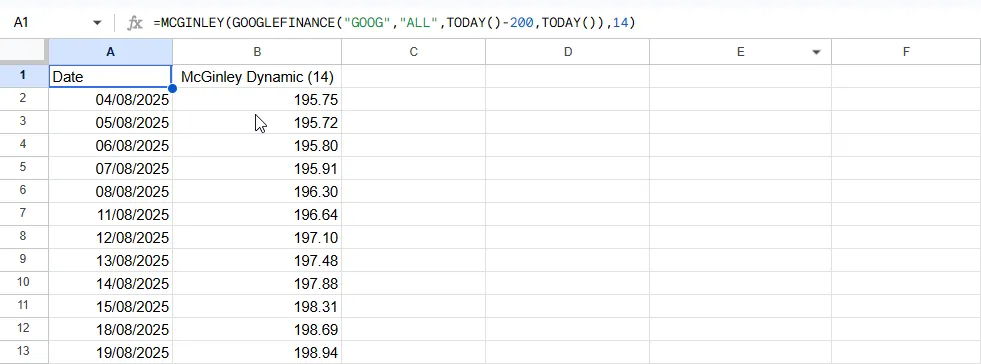
A two-column array of dates and their corresponding McGinley Dynamic values.
Source Code
Copy the following code into your Apps Script editor (Extensions > Apps Script) to use the MCGINLEY function in your spreadsheet.
mcginley.js
/**
 * Calculates the McGinley Dynamic indicator.
 * A moving average that adjusts to market speed to avoid lag and whipsaws.
 * Formula: MD[i] = MD[i-1] + (Price[i] - MD[i-1]) / (k * n * (Price[i]/MD[i-1])^4)
 * Where k is a constant (usually 0.6) and n is period.
 *
 * @param {array} data - The input range. Must include at least 2 columns: Date and Close (or Value).
 * @param {number} [period=14] - The lookback period (default 14).
 * @returns {array} A two-column array with headers "Date" and "McGinley Dynamic".
 * @customfunction
 */
function MCGINLEY(data, period = 14) {
    checkPremium();

    // Argument validation
    if (arguments.length < 1 || arguments.length > 2) {
        throw new Error(`Wrong number of arguments. Expected 1 or 2, but got ${arguments.length}.`);
    }
    if (period !== undefined) {
        if (typeof period !== 'number' || period <= 0 || !Number.isInteger(period)) {
            throw new Error(`Invalid period. The period must be a positive integer. Got: ${period}`);
        }
    }

    const processedData = getData(data);

    // Identify Value Column (Close)
    let valueIndex = 1;
    if (processedData[0].length >= 5) {
        valueIndex = 4; // Close
    }

    const dataRows = processedData.slice(1);
    const results = [["Date", `McGinley Dynamic (${period})`]];

    // Logic
    // MD requires a previous value.
    // Initialization: Usually SMA of first N periods, or just the first Price.
    // McGinley often starts simply at Price[0] because it adapts quickly.

    let prevMD = 0;
    // Constant N (roughly 60% of period is standard for the 'N' factor in the formula denominator
    // Wait, the formula usually cited is: MD + (Price - MD) / (k * N * (P/MD)^4)
    // Where k*N acts as the time constant.
    // Standard implementation uses N directly as the user input period.
    // Some sources say factor = N * 0.6. Let's use period directly as "N" in the standard formula context,
    // or verify if "k" is separate.
    // TradingView's code: `md = 0.0; md := na(md[1]) ? close : md[1] + (close - md[1]) / (k * n * pow(close/md[1], 4))`
    // where k is often 0.6.

    // Constant N (usually the period itself in TradingView implementation)
    // TradingView simplifies the formula by using N as the smoothing factor directly.
    // This effectively sets k=1 relative to the Investopedia definition.
    const n = period;

    for (let i = 0; i < dataRows.length; i++) {
        const row = dataRows[i];
        const date = row[0];
        const price = row[valueIndex];

        if (price === "" || price === null || typeof price !== 'number') {
            results.push([date, ""]);
            continue;
        }

        let md = 0;

        if (i === 0) {
            // Initialize with first price
            md = price;
        } else {
            // Formula
            // (Price / PrevMD) ^ 4
            if (prevMD === 0) prevMD = price; // Safety

            const ratio = price / prevMD;
            // Original McGinley: k * n * (ratio^4) -> k=0.6
            // TradingView: n * (ratio^4) -> k=1
            const denominator = n * Math.pow(ratio, 4);

            // Avoid division by zero or extreme values if price jumps wildly?
            // The formula handles it generally.

            md = prevMD + (price - prevMD) / denominator;
        }

        results.push([date, md]);
        prevMD = md;
    }

    // Trim Output
    // McGinley usually starts valid from index 0 if price is valid.
    // But if we encounter initial nulls (e.g. bad data), we trim.

    let firstValidIndex = -1;
    for (let i = 1; i < results.length; i++) {
        if (results[i][1] !== "" && results[i][1] !== null) {
            firstValidIndex = i;
            break;
        }
    }

    if (firstValidIndex !== -1) {
        return [results[0], ...results.slice(firstValidIndex)];
    } else {
        return [results[0]];
    }
}