 DEUSHARVEST
Rate of Change (ROC)
Rate of Change (ROC) is a pure momentum oscillator that measures the percentage change in price from one period to the next. The ROC calculation compares the current price with the price “n” periods ago.
ROC
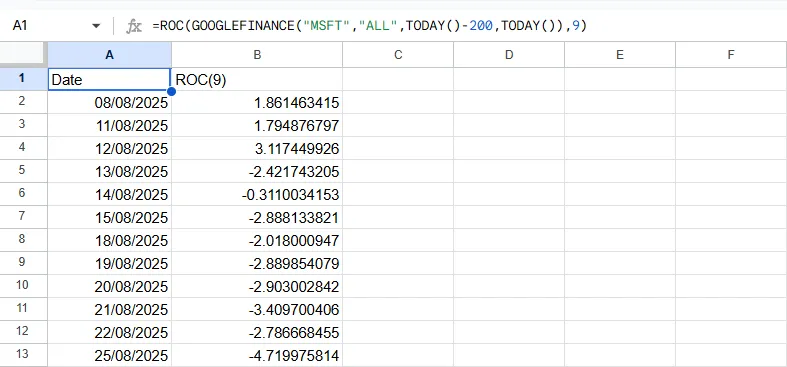
=ROC(data, period) Example Usage
=ROC(A2:F500, 9)
Parameters
| Parameter | Type | Description | Status |
|---|---|---|---|
data | Range | The input range of columns containing the Date, Open, High, Low, Close, and Volume data. | Required |
period | Number | The number of periods to look back (e.g., 9 or 12). | Required |
Returns
A two-column array of dates and their corresponding ROC percentage values.
Source Code
Copy the following code into your Apps Script editor (Extensions > Apps Script) to use the ROC function in your spreadsheet.
roc.js
/**
 * Calculates the Rate of Change (ROC) for a specified period.
 * ROC measures the percentage change in price between the current period and n periods ago.
 *
 * @param {array} data - The input range containing metrics. Can be a multi-column range (Date, Open, High, Low, Close, Volume) or a two-column range (Date, Value).
 * @param {number} period - The number of periods to look back (e.g., 9).
 * @returns {array} A two-column array with headers "Date" and "ROC".
 * @customfunction
 */
function ROC(data, period) {
    checkPremium();

  // Argument validation
  if (arguments.length !== 2) {
    throw new Error(`Wrong number of arguments. Expected 2, but got ${arguments.length}.`);
  }
  if (typeof period !== 'number' || period <= 0 || !Number.isInteger(period)) {
    throw new Error(`Invalid period. The period must be a positive integer. Got: ${period}`);
  }

  const processedData = getData(data);

  // --- NEW: Function-level validation ---
  const columnCount = processedData[0].length;
  if (columnCount > 2 && columnCount < 5) {
    throw new Error(`Invalid data structure for ROC. For multi-column data, expected at least 5 columns (Date, O, H, L, C), but got ${columnCount}. For simple data, expected 2 columns (Date, Value).`);
  }
  // --- END of validation ---

  const dates = processedData.slice(1).map(row => row[0]);
  const values = getValues(processedData);

  if (period >= values.length) {
    throw new Error(`Invalid period. The period (${period}) cannot be greater than or equal to the number of data points (${values.length}).`);
  }

  const results = [["Date", `ROC(${period})`]];

  for (let i = period; i < values.length; i++) {
    const prevValue = values[i - period];
    const currentValue = values[i];

    if (prevValue === 0) {
      results.push([dates[i], 0]); // Or handle as an error, depending on desired behavior for zero previous value
      continue;
    }

    const roc = ((currentValue - prevValue) / prevValue) * 100;
    results.push([dates[i], roc]);
  }

  return results;
}